
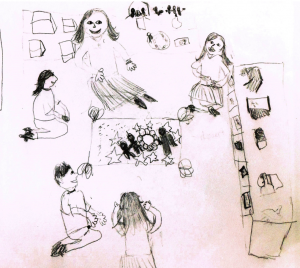
From a 2015 Meeting newsletter: Caryl sharing a story in the Godly Play room
West Hills Friends Church in Portland, OR has a long history with Godly Play and Faith & Play at the center of their children’s program. Caryl Menkhus Creswell (Godly Play trainer emerita) shared stories for many years and developed a beautiful room of materials that speak an unspoken message of the meeting’s commitment to the spiritual formation of the children in the community. The program continues with new storytellers and doorpersons, and the Meeting hosted a Playing in the Light training in 2023.
In April, the meeting’s current Children’s Education committee, clerked by Mylène DiPenta, brought forward to their Meeting for Worship for Business a proposed trifold brochure explaining the children’s program at West Hills Friends. “Children ~5-12 at West Hills Friends” shares both practical information that a new family would need to know — times, locations, and descriptions of worship and the children’s program — alongside clear messages of welcome. That welcome includes clarity of purpose about the children’s program; sections inside the trifold with the headings, Why?, I wonder . . . , and What? create spaces to share the meeting’s approach to children’s religious education and how the Godly Play/Faith & Play stories approach biblical content and Quaker faith and practice.
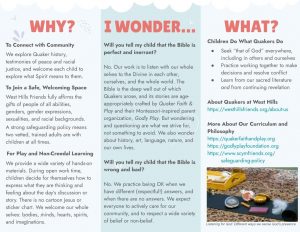 The Committee’s hope in developing the trifold brochure was that the information would be both reassuring and intriguing; supportive both of those who’ve experienced high-control religions, as well as those who haven’t experienced religion at all; and help both caregivers and children old enough to look/read become comfortable enough to ask more questions. The “Why” and “I Wonder…” sections touch on questions that families new to a Quaker faith community might want to ask; clearly stating what you won’t find in their children’s program (creedal learning, a literal/inerrant approach to the Bible or that the Bible is “wrong/bad”), instead emphasizing the importance of play, listening, and respecting different answers to theological questions.
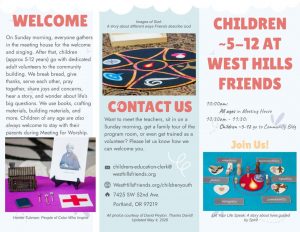 The brochure also includes vibrant photos of story materials with captions, and links to learn more about the meeting, the two curricula, and the Meeting’s child/community safety (safeguarding) policy. It is clearly designed with families in mind; the “Contact Us” section ends with the invitation: “Please let us know how we can welcome you.”
In the Godly Play method, we talk about a focus on “process over product” during the children’s response time after hearing a story. The journey for West Hills Friends working together on this document over several months also illuminates the importance of process. Mylène describes the Children’s Education Committee’s work together: “We worked really hard to take ideas that seem to conflict, and bring them into balance.”
Following the Committee’s work together, the Meeting wasn’t asked to approve the brochure; rather, the Committee asked Friends to worship on questions that would help the Committee continue their work. Opening the conversation to the whole Meeting also created the opportunity for the Committee to “zoom out” from their own conversations and seek what might be revealed by the wider circle of Friends. Preparing for the community discernment in meeting for business, the Committee invited feedback to refine the message of the trifold, asking the Meeting these queries:
- What does this brochure reveal about West Hills Friends?
- Is that what we want to reveal to the caregivers of children in the approximately 5-12 age range?
- What does the Meeting, collectively, believe that the Divine is guiding us toward, in our communication to those who are unfamiliar with our children’s programming?
Mylène explains: “While we didn’t expect the content to be especially controversial, people’s values about the treatment of children can run very deep, and be attached to profound experiences from their own childhoods, both positive and negative.” In approaching the discussion, the Meeting also took inspiration from previous conversations with the Friends Committee on National Legislation, and principles from that work available to support conversations that raise difficult feelings and experiences. From FCNL: “In moments where you’re not sure where to go next, invite people to tell stories from their own lived experience. […] Sharing personal stories has been proven to build empathy and understanding, even across deep differences.”
Mylène describes that an amazing thing happened at that meeting for business: “Several people approached us wanting to try being a doorperson. Some of them were new to the idea, and some of them were those who had been keeping an uneasy distance. Our schedule is full through to the fall!”
A practical tool for outreach and welcome, the program brochure is also an example of Godly Play principles and Quaker practices at work together – honoring group process, sharing stories, listening, and being open to continuing revelation.
Many thanks to Mylène and Friends at West Hills for sharing their story of process, and this wonderful resource for communication and community! If you’re interested in learning more or using this as a template for your own meeting brochure, the contact info is on the trifold linked below!